Candidate sourcing for independent recruiters
How to source candidates when you have no research team and no big tool budget: work to a defined bar, mine your own network, and track everyone you touch.
You do not have a research team pulling lists for you overnight. You do not have a seat license for every sourcing tool on the market. What you have is a phone, a LinkedIn login, whatever job board access you already pay for, and the goodwill of everyone you have placed or spoken to over the years. That is a smaller kit than an in-house talent team carries, and it is enough. Independent recruiters place candidates every day with exactly this.
The trap is thinking the answer is more. More names, more messages, more tools. It almost never is. The recruiters who struggle on a small setup are usually spraying keywords into a search bar and mailing everyone who comes back. The ones who do well are working a much shorter list, on purpose, against a bar they defined before they opened a single tab.
Source against a bar, not a keyword
Before you type anything into a search box, you need to know what you are looking for. Not a vague sense of the role. A written bar. The three or four things that actually decide whether the client says yes, and the one thing that gets a candidate ruled out on sight.
This is the same work as building a fitment checklist, and it pays off twice. Once when you screen, and once here, before you have screened anyone at all. Keyword search finds people who used the right words on their profile. It does not find people who can do the job. Those are different sets, and the gap between them is where your wasted hours go.
So flip the order. Decide the bar, then work backwards to where those people are and what they would have written about themselves. Someone who has actually done the thing the client needs will describe it in the language of the work, not the language of the JD. Search for the work. A person who managed a specific kind of migration will say so plainly. The keyword tourist will have the buzzword and nothing under it.
When you source to a bar, your numbers get smaller and your submissions get better. That is the trade the whole job turns on.
Start with people you already know
Your first source is not a database. It is your own contacts. Every candidate you have ever placed, every strong person you interviewed and could not place, everyone who has ever replied to you with something useful. These people are warm. They know your name, they have some reason to trust you, and a good number of them are quietly open to a move even when they are not looking.
Most independent recruiters underuse this list badly. They treat a placed candidate as done and never speak to them again until they need something. Then the message lands cold, and it shows. The fix is to have stayed in touch, which is a habit you build over months, not a thing you can fake the week you need it.
Go back through your past candidates for this mandate specifically. The senior person you placed two years ago knows exactly who is good in their field, because they work alongside them. The strong candidate the client passed on last time may be perfect for this seat. You already did the screening once. That work does not expire.
If you have been running your desk well, this list is searchable, tagged by skill and seniority, with notes on who was good at what. If it lives in your head and your inbox, that is the first thing to fix, and we will come back to it.
Ask for referrals like you mean it
Referrals are the best candidates you will ever get, and most recruiters ask for them so weakly that nobody bothers to reply. “Do you know anyone who might be interested?” is a question people skim past. It asks them to do your thinking for you.
Ask better. Be specific about who you want, make it easy to answer, and give them a reason that is not just your benefit. “I am hiring a person to lead a small support team, remote, and I thought of you because you have built one of those. Is there anyone from your last company you rated who I should be speaking to?” That names a person, a shape, and a reason. It is answerable in one line.
Ask the people best placed to know. A strong candidate who turned down your role can often point you at two others in the same orbit. So can someone you just placed, in their first weeks, when goodwill is highest and they still remember every good person from their old team. Ask at the moment the relationship is warmest, not months later when it has cooled.
And close the loop. When a referral turns into a conversation or a placement, tell the person who referred them. That one message is why they will refer to you again. Recruiters who get a steady flow of referrals are almost always the ones who say thank you and mean it.
Make free tools do the work
You do not need a seat on every sourcing platform to source well. You need to use two or three properly.
LinkedIn’s free search is blunter than the paid tiers, and it is still enough for most independent desks if you are precise. Search for the work, not the title, because titles are inconsistent across companies and the words people use for what they did are not. Use the company filter to hunt inside the two or three firms that grow the kind of person your client wants. Look at who engages with the right content and who is connected to the strong people you already know. The paid tools save time at volume. They do not find candidates the free version cannot see.
The job boards you already pay for hold a database, and most recruiters only ever use the job-posting side of them. The resume search side is often the better half. People who applied to something adjacent last month are active and reachable now. Search that pool before you buy access to another.
Referrals, your own bench, and precise free search will carry the large majority of your mandates. Reach for a paid tool when a specific, hard search genuinely needs it, not as your default. On a small budget, spending should follow a search you cannot crack any other way, and most searches are not that.
Write outreach that gets a reply
Cold outreach works. Bad cold outreach does not, and there is a lot of it, which is your opening. When most of what a good candidate receives is a generic wall of text, a short and specific message stands out just by being human.
Keep it to two or three lines. Name why you are contacting this exact person, not the ten thousand people who share their title. One concrete detail about the role that would actually matter to someone in their seat: the scope, who they would report to, the reason the seat exists, the fact that it is remote if that is rare in their field. Then a low-pressure question that is easy to answer, something like whether they would be open to hearing more. That is the whole message.
Leave out the things that kill replies. No salary dangled as bait before you know what they earn. No fake urgency. No paragraph about your firm that they did not ask for. And no lie about why you picked them, because people can tell, and a recruiter who opens with a hollow compliment is a recruiter they will not trust with their career.
If your channel is a messaging app rather than email, the same rules hold, only tighter. There are specific habits worth learning for recruiting over WhatsApp, because a message app is more personal than an inbox and a clumsy first line reads worse there. Short, specific, and respectful still wins. It just matters more.
Keep a warm bench between mandates
The recruiters who source fastest are the ones who did not start from zero. They have a bench: a running group of strong people, in the fields they work, who they are loosely in touch with whether or not there is a live role. When a mandate lands, the first two names are already there.
Building a bench is a small habit repeated. When you speak to someone good who is not right for today’s role, you do not drop them. You note what they do, what they want next, roughly when they might move, and you check in now and then with something that is actually useful to them rather than a pitch. A relevant piece of market news. A quiet heads up that their kind of role is heating up. Nothing that asks them for anything.
This is slow to build and impossible to buy, which is exactly why it is worth having. It is also the thing that gets squeezed out first when you are busy, because it has no deadline attached. Protect a little time for it anyway. A bench of thirty people you actually know is worth more than a database of thirty thousand you do not.
Track everyone, or lose them
Here is the failure that quietly costs independent recruiters the most. You source a strong candidate, they are busy that week, you get pulled onto another fire, and they fall out of the pipeline. Not rejected. Just forgotten. Next month you cold source someone worse for the same kind of role, never knowing you already had a better person one nudge away.
The only defence is a record. Every person you contact, when you contacted them, what they said, and the next thing you owe them. Without a next action against a name, that name dies. With one, you follow up on the day you said you would, and following up is where a surprising share of placements actually come from.
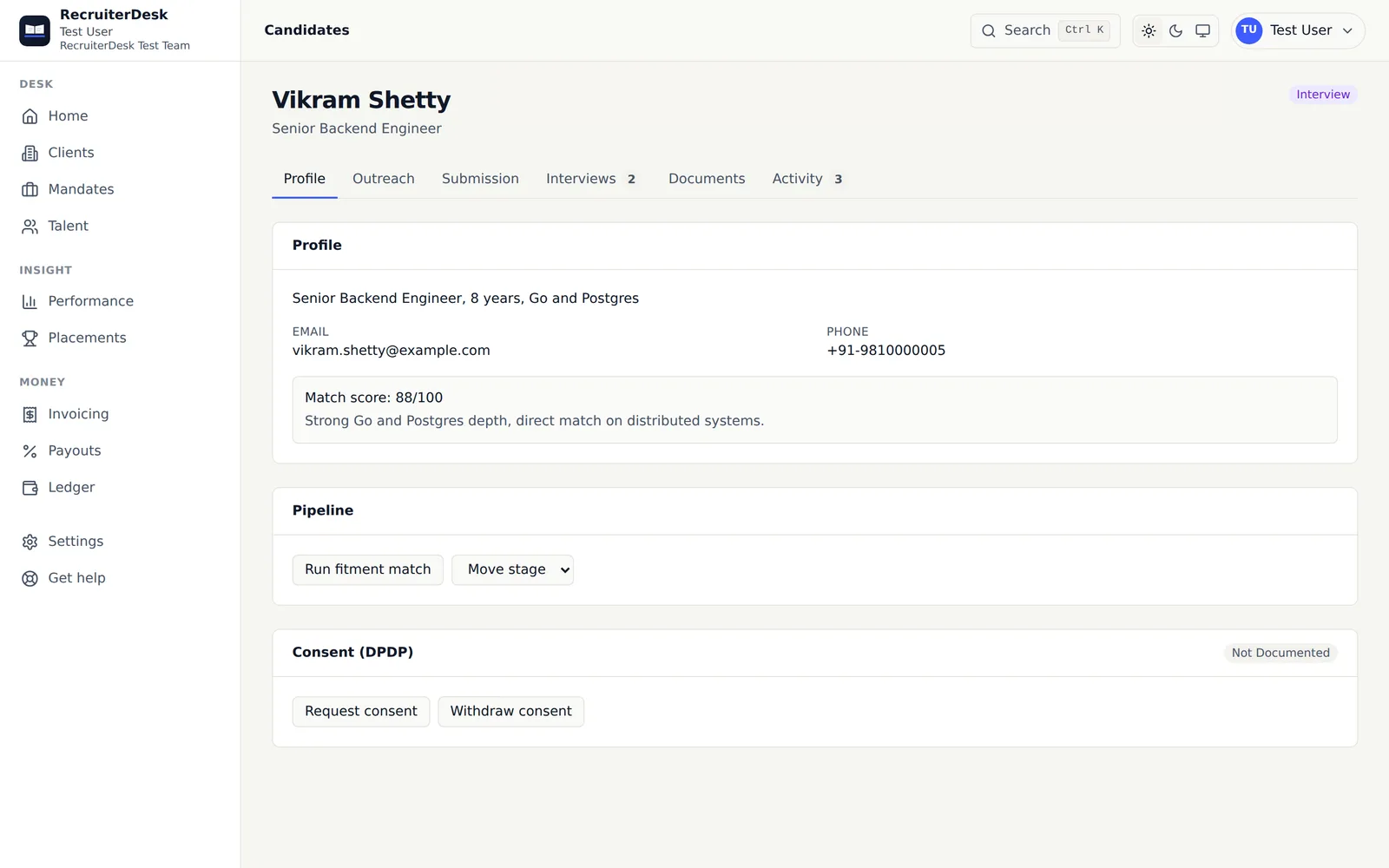
This does not need to be complicated. A recruiting CRM like RecruiterDesk keeps the contact history and the next step against every candidate and every mandate, which is the point of using one over an inbox and memory. If you are on a spreadsheet for now, keep two columns honest above all others: date of last contact, and next action. Tracking is also what makes the rest of running the whole mandate hold together, because a client asking for an update should never catch you guessing who you spoke to.
Sourcing well on a small setup is not about reach. It is about working a shorter list, warmer, to a clearer bar, and never letting a good person slip through because you did not write them down. Do that and the small kit stops feeling small.
Frequently asked questions
Where should an independent recruiter start sourcing with no tool budget?
Start with people you already know. Your past candidates, placed and not placed, and the people they can refer are warmer than anyone you will cold source, and they cost you nothing. Only after you have worked that list should you move to LinkedIn search, job board databases you already pay for, and targeted outreach. The free sources are also the best sources, which is convenient when the budget is small.
How many candidates should I source for one role?
Enough to submit three or four you would genuinely stand behind, not more. Volume is a symptom, not a goal. If you are contacting fifty people to find one fit, your bar is wrong or your outreach is wrong, and adding another twenty names will not fix either. Fix the brief with the client, tighten your checklist, and the numbers you need drop fast.
What makes a cold outreach message actually get a reply?
Length, specificity, and respect for their time. Two or three lines that name why you are contacting this exact person, one concrete detail about the role that matters to them, and a low-pressure question. No wall of text, no salary bait, no fake urgency. People reply to messages that read as if a human who did their homework wrote them, because most of what they receive is not that.
How do I keep track of everyone I have contacted?
Any system you will actually update beats the best system you abandon. A recruiting CRM like RecruiterDesk keeps the contact history, the stage, and the next action against each candidate so nobody gets messaged twice or forgotten. If you are on a spreadsheet for now, that is fine, as long as it has a date of last contact and a next step for every open name.