Every placement and its fee, tracked to collected.
When a candidate joins, RecruiterDesk records the placement, works the fee out from the client's terms, and tracks the receivable from raised to collected. Clawback is built in, the delivery credit is drafted for the team, and nobody types a fee into a blank field.
From a join to a collected fee, without the spreadsheet.
A candidate joins
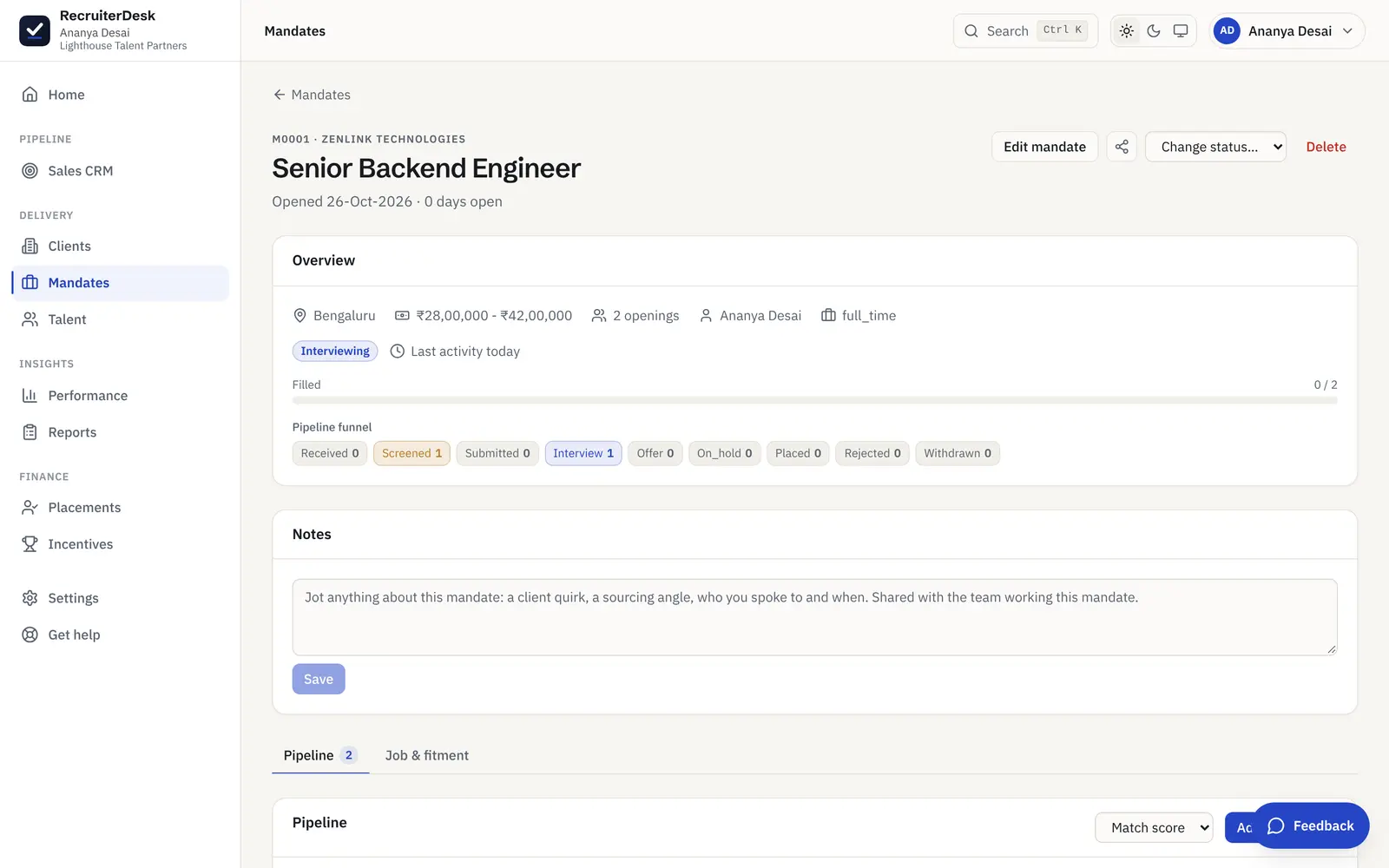
Mark the actual joining date on the mandate and RecruiterDesk records the placement. "Placed" always means joined, so the money side only ever starts on a real start.
The fee works itself out
The billed fee is derived from the client's commercial terms: a percent, a flat amount, or a slab by grade, with any agreed uplift or penalty applied. No one types a number into a fee field.
You track it to collected
Each placement carries one receivable, moved from draft to raised to collected, with a clawback if the candidate exits early, so what the client owes is never out of sight.
How the bill is reached, line by line.
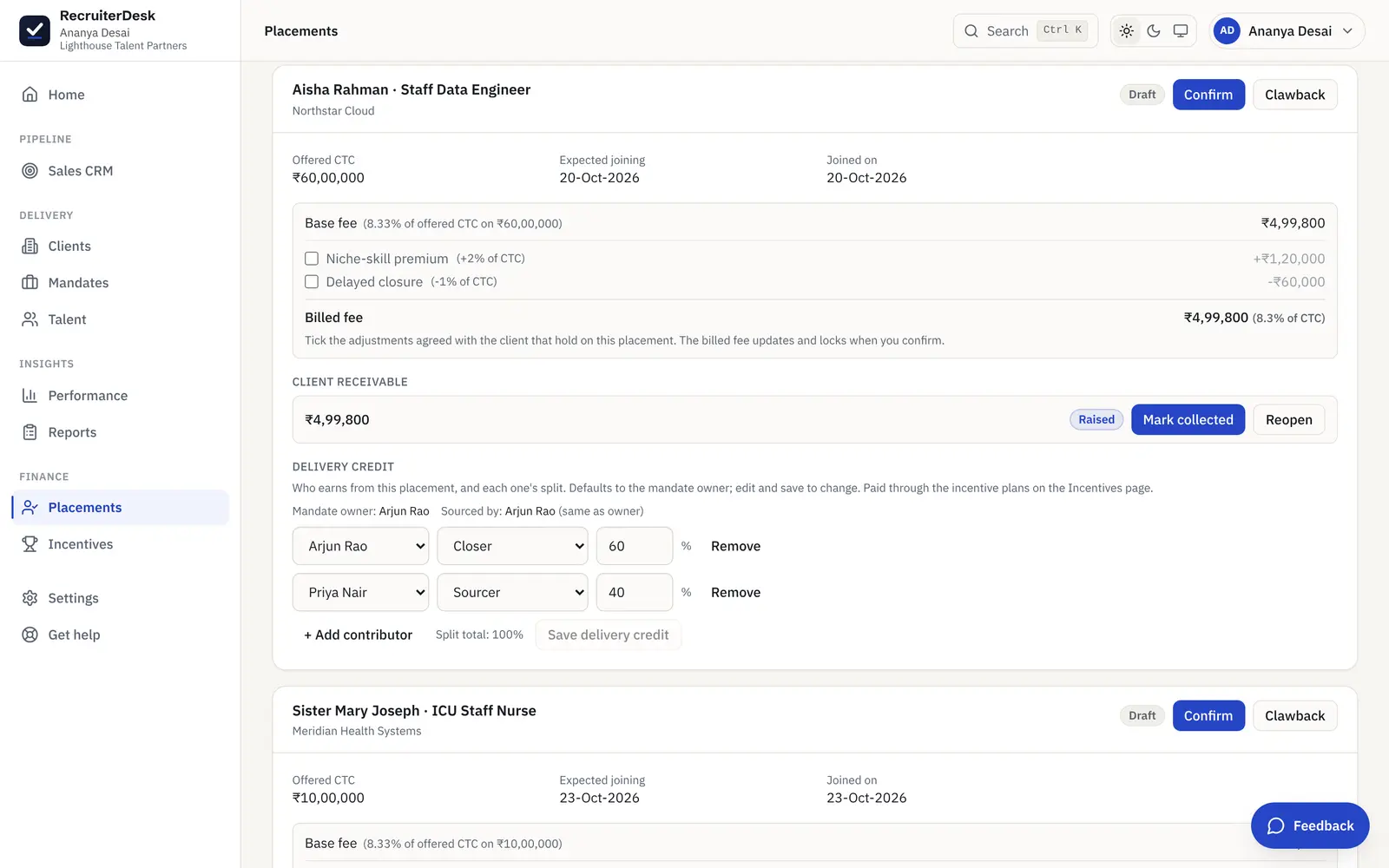
Each placement card shows the base fee (the offered CTC or fixed pay at the client's rate), then each agreed adjustment finance ticks, ending at the billed fee and its percent of CTC. You can see how the fee came off the offer at a glance, and the amount is locked once you confirm it, so a figure is never quietly changed.
- A readable fee breakdown on every card
- Receivable moved from draft to raised to collected
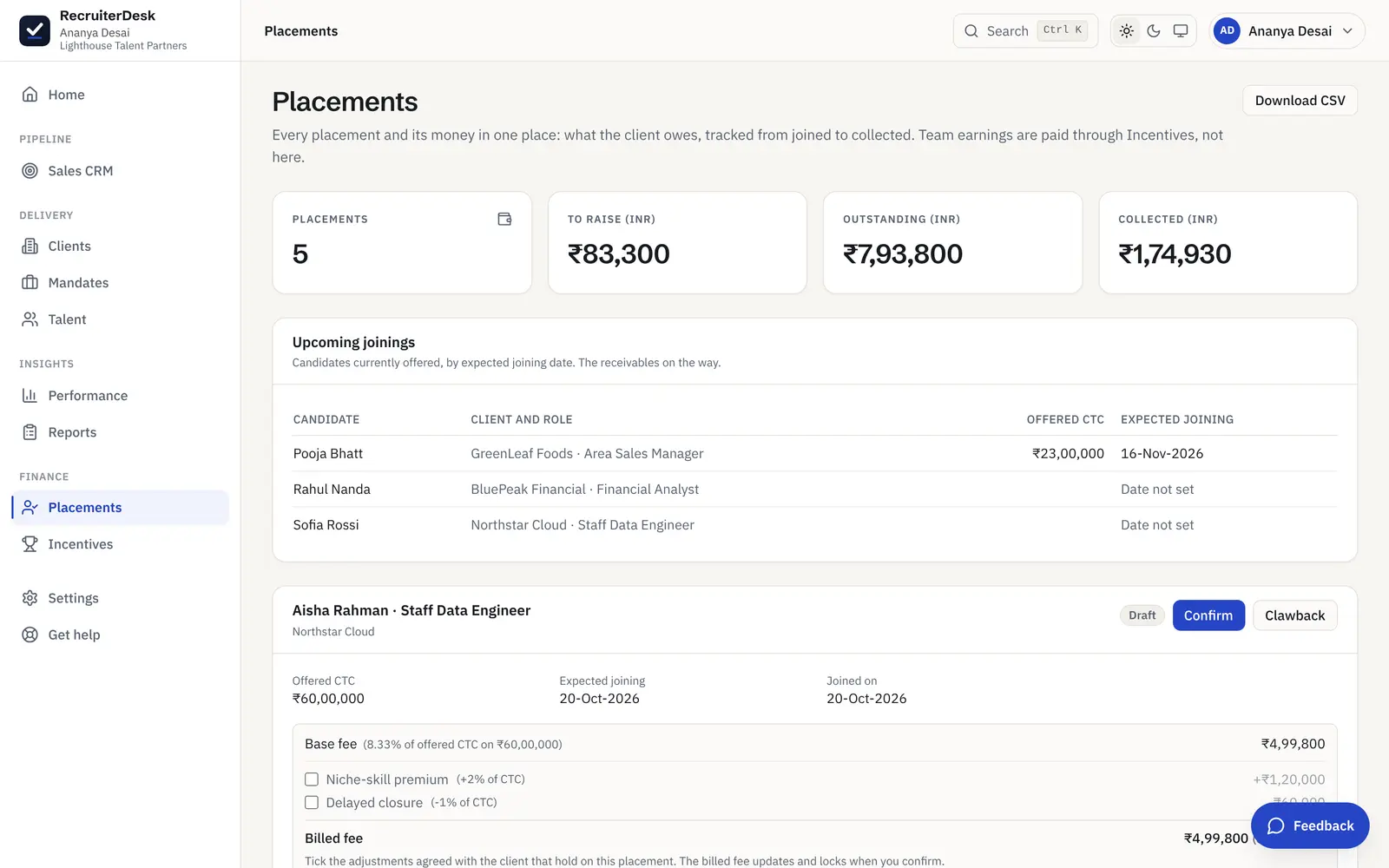
- Upcoming joinings, so the receivables on the way are in view
The back office of a placement, handled.
Fees from the terms
Set a client's commercial terms once (model, rate, minimum, currency, payment days, clawback window and named adjustments) and every placement fee is worked out from them, consistently.
One card per placement
The candidate, client and mandate together, the deal facts, the fee breakdown line by line, and the receivable, so how a bill was reached is readable rather than a mystery.
Clawback built in
If a placement falls through inside the window, a clawback reverses the receivable and marks it replaced, so a reversal is a controlled action, not a manual correction.
Delivery credit, then paid
Who earns from a placement is set here as a delivery credit, split across the people who delivered, and paid through the incentive plans, so a placement pays its team one way, never two.
The team's earning stays separate from the client's bill.
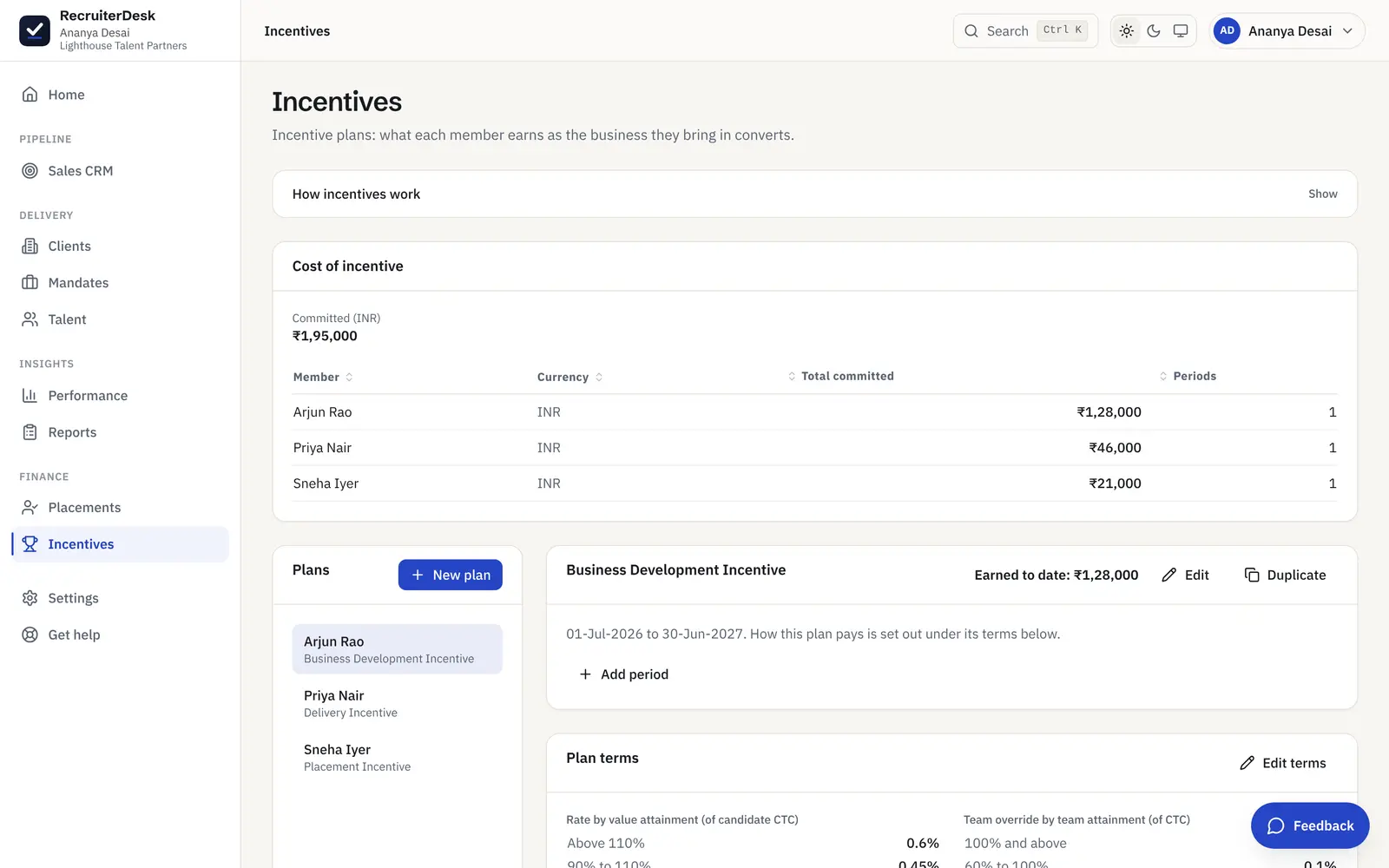
The delivery credit set on a placement feeds the incentive plans, where each recruiter is paid on what they delivered. The client receivable and the team payout never get tangled, so you can see what is coming in and what is going out as two clean lines.
- Delivery credit split across the people who delivered
- Paid through the incentive plans, not twice
- GST-aware fee handling for an Indian desk
Placements and settlements, answered.
What is settlement in recruitment?
Settlement is the money side of a placement: what the client owes once a candidate joins, and what the delivery team earns from it. In RecruiterDesk the client receivable is tracked on the Placements screen, from joined through to collected, and the team's earning is paid through the incentive plans, so the two sides stay clear of each other.
How is the placement fee calculated?
From the client's commercial terms, set once on the client record. The fee model can be a percent of CTC, a flat amount, or a slab by the offered grade, with a minimum floor and any agreed uplifts or penalties applied. When a candidate joins, the billed fee is worked out from those terms, so no one keys a figure in by hand.
What happens if a placed candidate leaves?
A clawback reverses the receivable and marks the placement replaced, and on the incentive side the earning is recovered if the exit falls inside the clawback window, unless it was client-initiated. The reversal is a deliberate, recorded action rather than an edit someone has to remember to make.
Is this the same as the old Settlements screen?
The money side now lives on one Placements surface: client receivables, the fee breakdown, confirm and clawback, and the editable delivery credit are all there. The separate Settlements and Payout rules pages were folded into it, so there is a single place a placement is worked from joined to collected.
Who can see the finance side?
Placements is a finance surface. The owner and members with the finance module can open it; a delivery recruiter records a join from the mandate pipeline, and finance confirms and settles it here. The split keeps the money visible to the people who own it without exposing it to the whole desk.
- 14-day free trial The whole product, no credit card and no setup call.
- One flat price Every feature included, no per-feature upsells or tiers.
- Your data is yours Export it or delete it whenever you want.
Track every fee from the join to the bank.
Set your client terms once, record a join, and let RecruiterDesk work out the fee and the payout. Free for 14 days, no card.