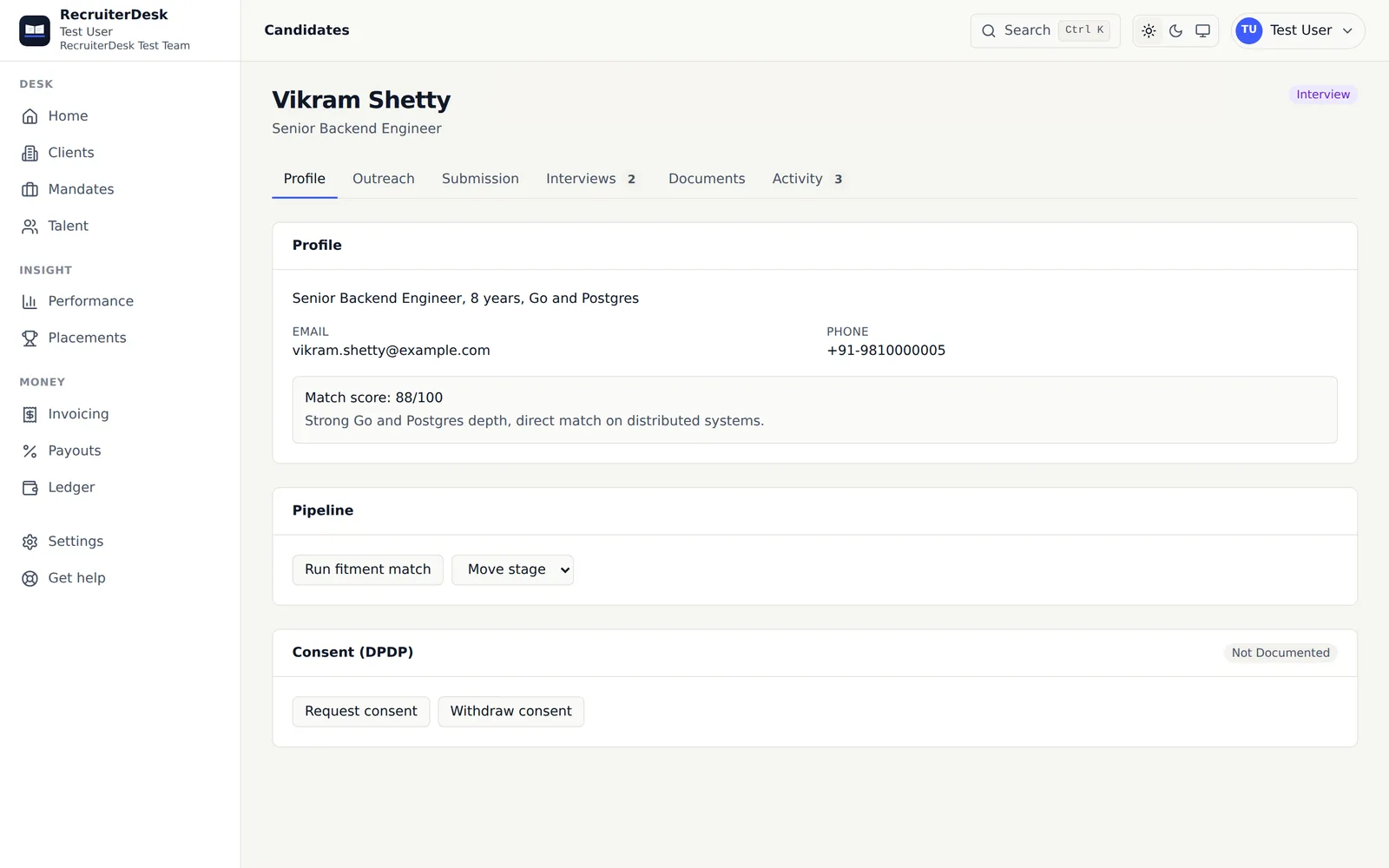
A candidate database that remembers everyone you have met.
Your network is your best source, but only if you can find the right person again. RecruiterDesk keeps every candidate in one searchable database, ranks your own pool against each new role, and recalls the senior people who said they would move, so your next shortlist starts with people you already know.
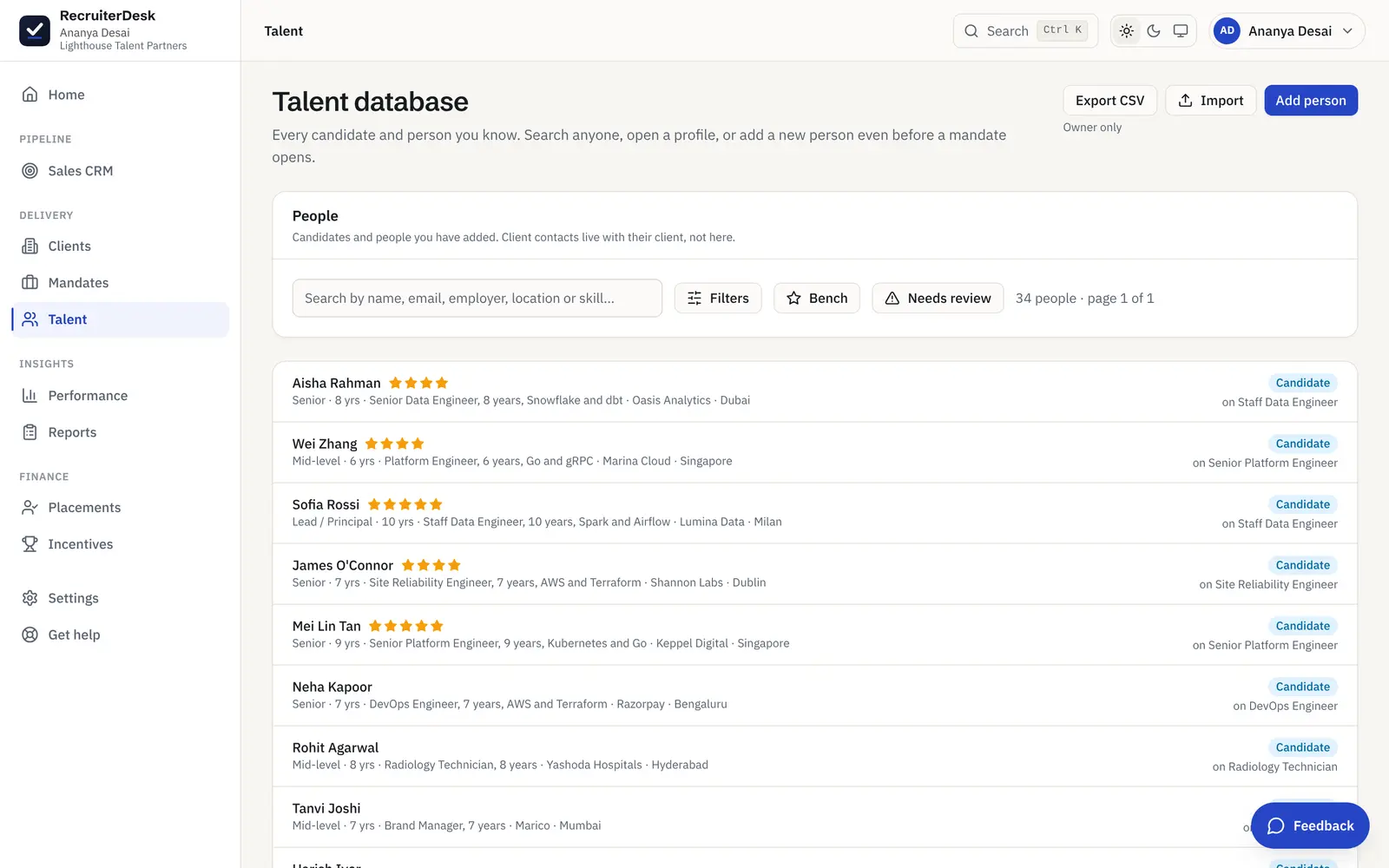
From a pile of CVs to a pool you can work.
Fill it fast
Drop a backlog of resumes as PDF, DOC, DOCX or a ZIP and each is read into a structured record, or map a CSV export from your old tool and load people with the same dedupe. The database starts full, not empty.
Find anyone in seconds
Search by name, email, phone, role, employer, location, skill or your own tags, then narrow by experience, expected CTC, notice, talent tier or inferred seniority. The right shortlist is a filter, not a scroll.
Reuse who you know
When a mandate has a fitment checklist, the people already in your pool are ranked against it, so the first shortlist comes from candidates you have already met, not a cold search.
Filters that match how a recruiter actually searches.
Search the whole directory by name, email, phone, role, employer, location, skill or your own tags, then narrow it: an experience band, an expected-CTC ceiling, a notice limit, a talent tier, an inferred seniority band. A Bench shortcut shows your four-star-and-up people strongest first, the reverse-headhunting view in one tap.
- Search across every field, including your own tags
- Filter by experience, CTC, notice, tier and seniority
- A Bench view of the strongest people you have met
Your pool, ranked against the role on your desk.
Once a mandate has a fitment checklist, RecruiterDesk ranks the people already in your database against it: a fit score, the must-haves met, any knockout flagged, and a note where consent is not documented. Among equal matches, a higher talent tier ranks first, so the senior people on your bench surface ahead of an unrated peer. It is computed on demand, from your live records.
- Matches ranked by the mandate's own checklist
- A consent flag where data is not documented
- Senior, flagged people surfaced ahead of the rest
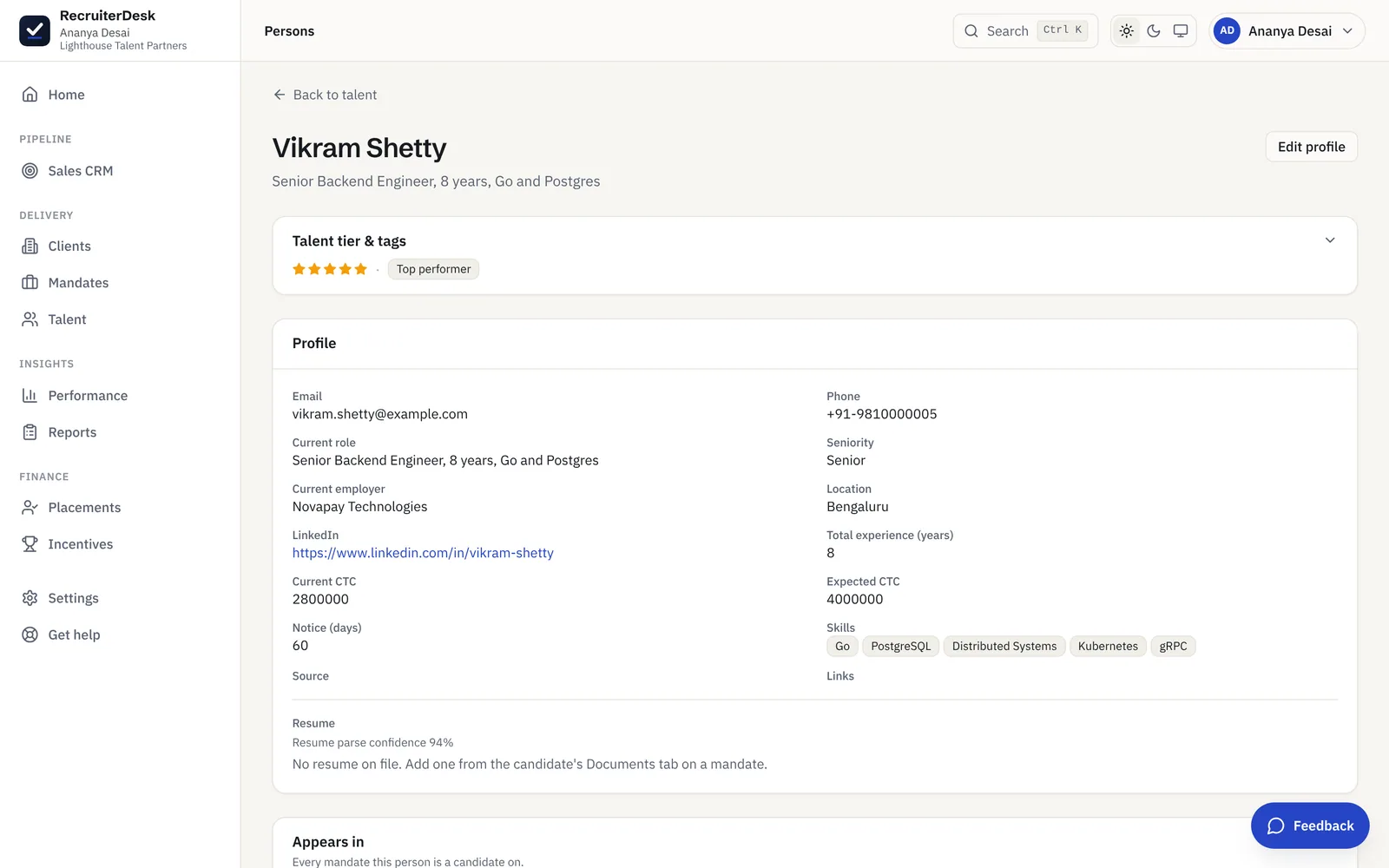
A database that is worth keeping, not just storing.
Filters that match how you search
Narrow by skills, location, an experience band, an expected-CTC ceiling, a notice limit, a talent tier, a tag, an inferred seniority band, or whoever is open to a move. A missing number never drops a person from a range search.
Ranked against a live mandate
A Suggested-from-pool panel ranks your own people against a role: fit score, must-haves met, any knockout flagged, and a note where consent is not documented. Computed on demand, from your live database.
Talent tier, tags and seniority
Rate a person one to five stars, tag them in your own words, and read a seniority band inferred from their CV. The standout people stay findable and surface ahead of the rest in a mandate's suggestions.
A review queue for weak parses
A resume that parsed with low confidence lands in a Needs review queue with a badge, so a sparse or hard-to-read CV gets a one-tap re-parse or a human check rather than drifting into the pool unnoticed.
Open to opportunities, recalled on the spot
Mark a person open to a move and the date is stamped, so when a client asks on a call for a senior person who would shift, you filter open plus seniority plus skill and have the names there and then, with no mandate open.
Consent and export per person
Every person carries consent, withdrawal, export and erasure, with an audit trail, and the whole filtered set exports to CSV for the owner. Candidate data is handled to the standard DPDP expects.
What is the best candidate database for an agency recruiter?
What is a recruitment candidate database?
A recruitment candidate database is the searchable record of every person a recruiter has met: candidates, applicants and people kept on the bench for later. In RecruiterDesk it is one deduplicated directory, searchable by name, email, phone, role, employer, location, skill and your own tags, and filterable by experience, expected CTC, notice, talent tier and inferred seniority. One person has one profile, so the same candidate is never scattered across sheets, and the people you already know are a search away the next time a role opens.
How do I find the right candidate for a role in my database?
Two ways. Search and filter the directory directly, by skill, location, experience band, expected CTC, notice, tier or seniority, or open a Bench view of your strongest, four-star-and-up people. Or, once a mandate has a fitment checklist, let RecruiterDesk rank the people already in your pool against that role, with a fit score, the must-haves met and any knockout flagged, so your first shortlist is built from candidates you have already worked.
Can I mark candidates who are open to a new role?
Yes. A person carries an "open to opportunities" flag that stamps the date you set it, so a fresh signal reads differently from a stale one. When a client asks for a senior person who would move, you filter on open plus seniority plus skill and recall the shortlist on the spot, with no mandate created. It is the reverse-headhunting view your own network has always been worth, finally searchable.
How do I get my existing candidates into the database?
Drop your resumes in bulk as PDF, DOC, DOCX or a ZIP and each is read into a structured record, deduplicated on email and phone. If you are switching from another tool, a guided spreadsheet import maps your old CSV export onto the talent fields, shows a dry-run preview, and loads people with the same dedupe, so a switching desk starts full on day one rather than empty.
What does RecruiterDesk read from a resume?
Current role and employer, location, total experience, notice period, skills and a seniority band inferred from title, scope and years together, plus a parse confidence. A low-confidence read is flagged and collected in a Needs review queue, where one tap re-parses the resume or marks the record checked, so a weak parse is never trusted silently.
Is the candidate data handled to a data-protection standard?
Yes. Consent, withdrawal, export and erasure are tracked per person with an audit trail, and the design follows India's DPDP expectations, with the customer as the data fiduciary and RecruiterDesk as the processor. A bulk CSV export of the whole pool is restricted to the workspace owner and written to the audit log, so the clearest data-out action leaves an accountable trail.
The rest of the desk around your database.
Bulk resume import
Drop a ZIP of CVs, or map a CSV from your old tool, and each person lands deduplicated and searchable.
Learn moreAI recruitment software
The AI reads a JD, drafts the weighted fitment checklist and scores each candidate with reasons.
Learn moreApplicant tracking system
Run every open role on a real pipeline, with each candidate scored against the mandate.
Learn more- 14-day free trial The whole product, no credit card and no setup call.
- One flat price Every feature included, no per-feature upsells or tiers.
- Your data is yours Export it or delete it whenever you want.
Turn your network into a database you can work.
Bring your resumes in, filter to the right people, and rank your own pool against a live role. Free for 14 days, no card.