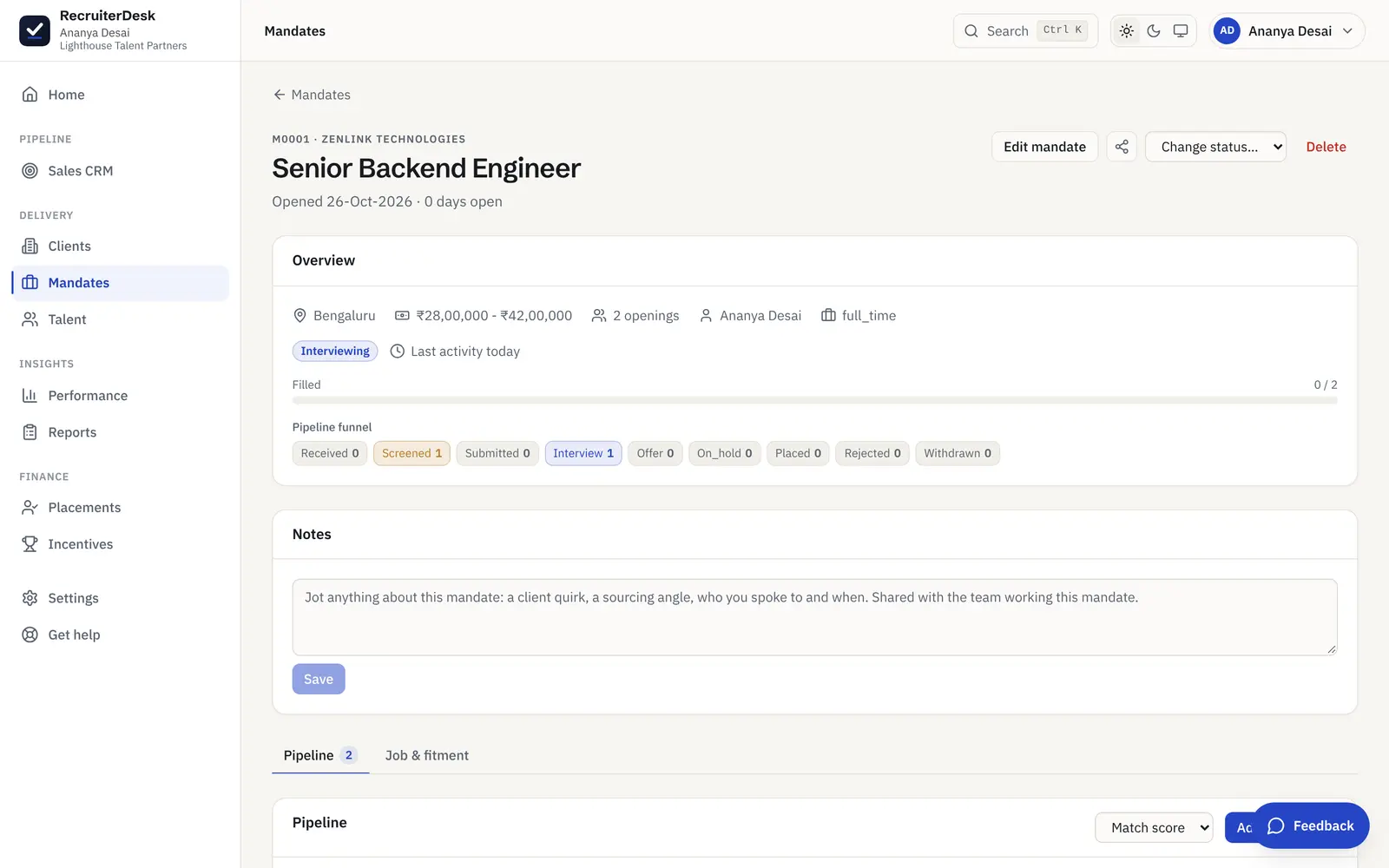
Pay your recruiters on exactly what they bring in.
RecruiterDesk turns your incentive scheme into plans that run on the real pipeline. Set a structure per member, let the engine apply it to the mandates, placements and CTC already on the desk, and give everyone a statement they can read. No parallel spreadsheet, no month-end reconstruction.
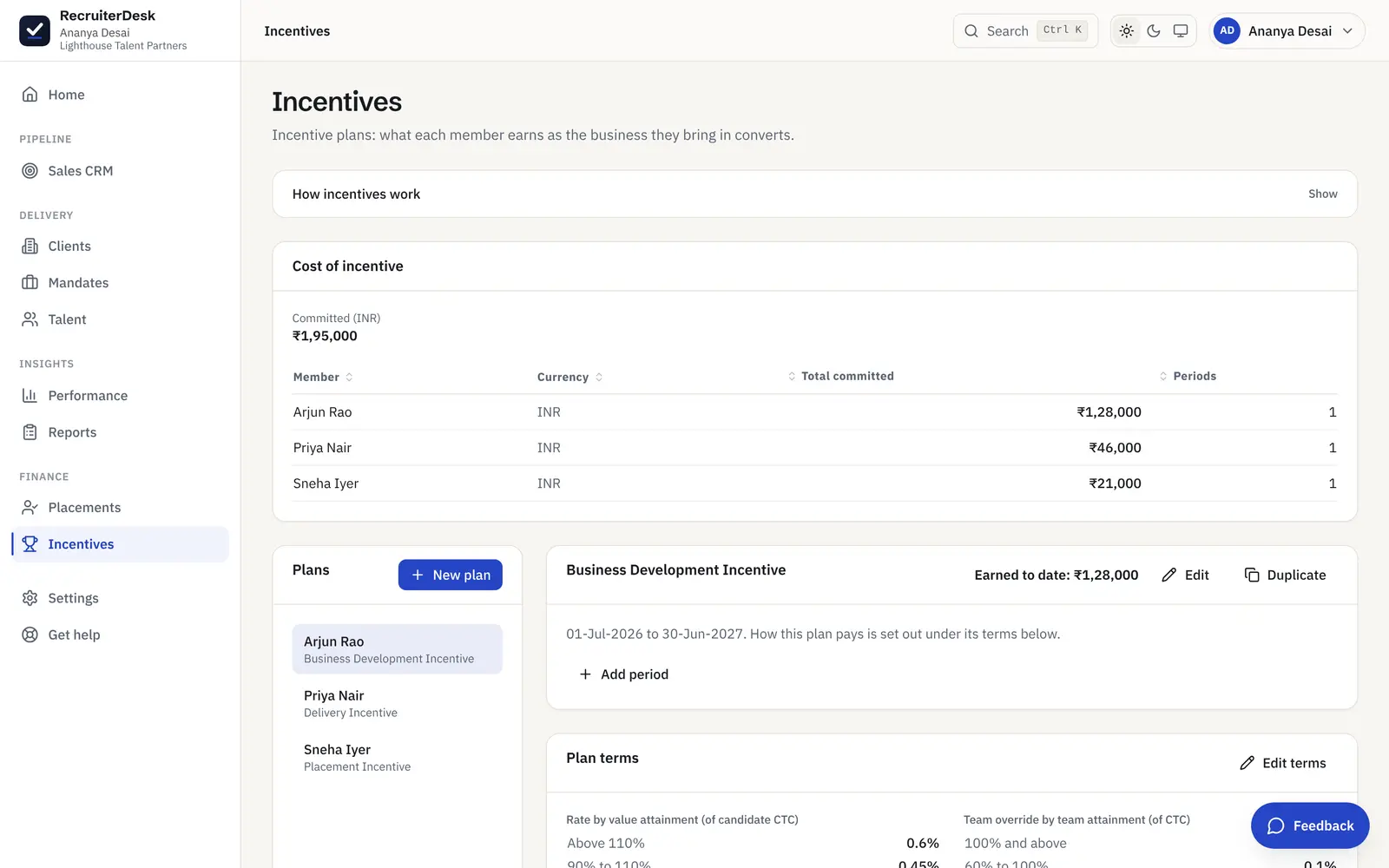
A plan shape for how each person earns.
Acquisition
Reward the person who brings the business in. A rate on the value a member signs over a period, banked on that period's mandates and paid as each candidate converts, with an optional bridge and a team override.
Delivery
Pay the recruiters who deliver. A commission linked to SLA compliance, so the people who fill roles on time earn on the work they turned around.
Placement
A flat rate on each placed candidate's first-year CTC, floored at a per-placement minimum, with a clawback window if the candidate leaves early.
Customer success
Pay on the growth of the accounts a member holds, so expanding an existing client is rewarded the same as winning a new one.
The earning follows the work, not a side sheet.
Because the incentive reads the same records as the rest of the desk, a member's number moves as the pipeline moves. A mandate signed, a candidate placed, a CTC confirmed: each updates the earning to date, so there is nothing to tally by hand and nothing to argue about at month end.
- Earning computed from live mandates, placements and CTC
- Rate tables you set, applied the same way every time
- A plain-language note on how each plan pays
The client receivable and the team's earning stay separate.
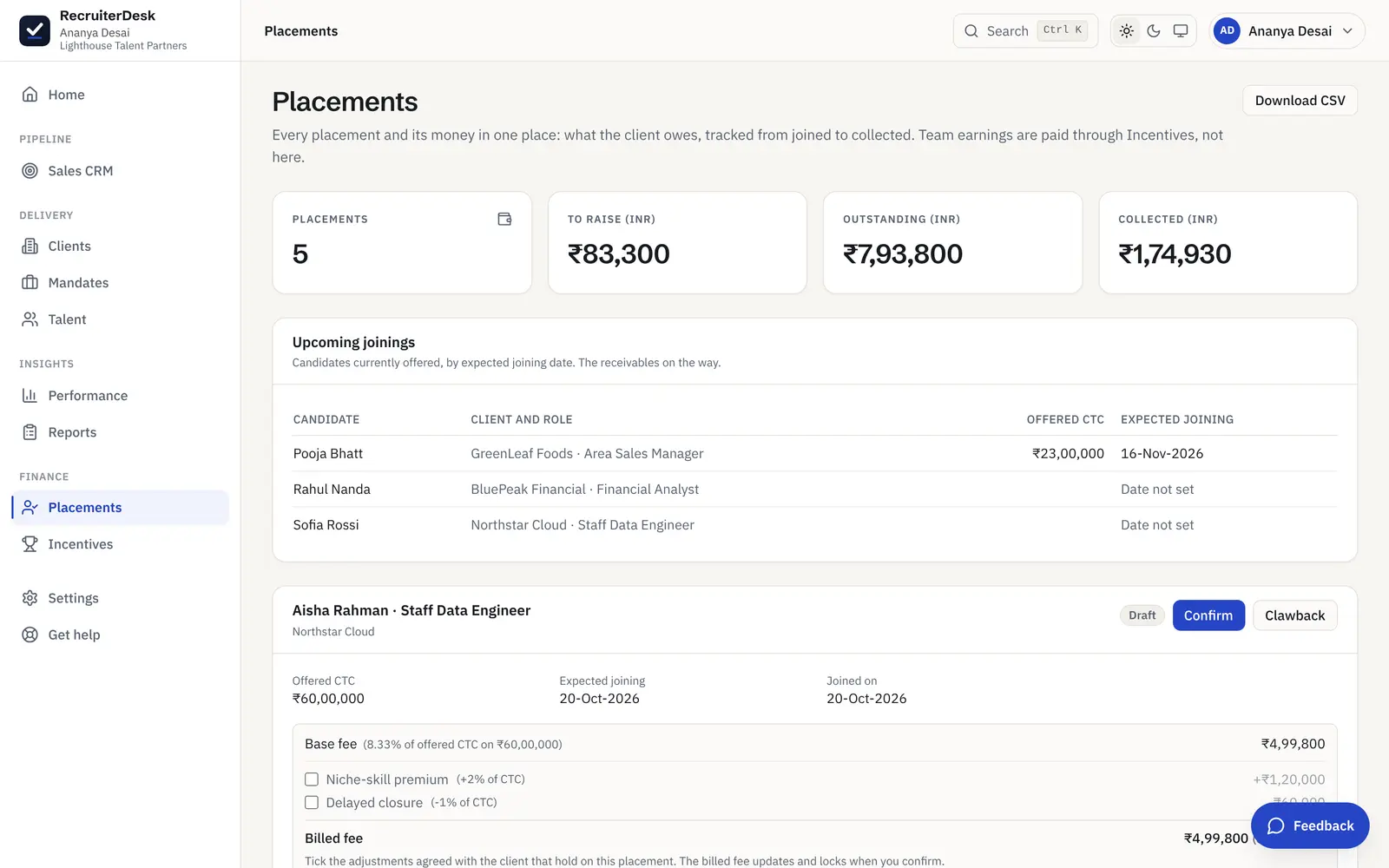
On Placements, RecruiterDesk tracks what the client owes, from joined through to collected. Who earns from that placement is set there as a delivery credit and paid through the incentive plans, so the money a client pays in and the money the team takes out never get tangled, and a candidate exit claws the earning back on its own.
- The receivable tracked on Placements, the payout on Incentives
- Delivery credit split across the people who delivered
- Automatic clawback inside the window on an early exit
Everything the scheme needs, nothing it does not.
Plans as data, not code
Each plan is composed from a fixed library of components. You set the rate tables and the numbers; the shape is configuration, so you build your own structures without a developer.
Periods and banking
A plan runs in periods, monthly or quarterly as you define them. Close a period and its statement is frozen, so a banked rate is never re-decided when you edit terms later.
A statement per member
Every closed period produces a statement with a line per component and its basis, marked paid or owed, so each person can see exactly how their number was reached.
The cost, in view
A cost-of-incentive total sums the committed spend per currency, with a per-member breakdown, so the owner always knows what the plans are adding up to.
Recruitment incentives, answered.
What is recruitment incentive software?
It is the part of a recruitment platform that works out what each recruiter earns on the business they bring in and the placements they deliver. RecruiterDesk ties the incentive to the real pipeline, so a member's earning is computed from the mandates, placements and CTC already on the desk, not from a separate spreadsheet someone maintains by hand.
How are recruiter commissions calculated?
You set a plan per member from a fixed library of structures (acquisition, delivery, placement or customer success), each with its own rate table. As candidates convert and placements are recorded, RecruiterDesk applies the plan to the live data and shows the earning to date. When a period closes, the statement is frozen so the figure is final.
Can the incentive be clawed back if a candidate leaves?
Yes. A placement plan carries a clawback window in days. If a placed candidate exits inside that window, the earning is recovered, unless the exit was client-initiated, so the team is not penalised for a decision outside their control.
Does this replace the per-placement payout?
The incentive plans are how the delivery team is paid, kept separate from the client receivable on a placement. The receivable (what the client owes) is tracked on Placements; who earns from the placement is set there as a delivery credit and paid through the incentive plans, so there is one way a placement pays its team, never two.
Can one plan cover a whole role, and what happens when I change the terms?
Yes. A plan can be assigned to a specific member or keyed to a role, so every recruiter on that role inherits one shared plan instead of a copy each, and an explicit per-member plan always overrides it for anyone on bespoke terms. Plan terms are effective-dated and versioned: editing them opens a new version from a date you set and keeps the old one, and each period is worked out against the version in force when it started, so changing terms never re-decides a period that already ran.
Is incentive management available on every plan?
Incentive plans are a team feature, since they reward members across a desk. Every feature is included in the plan price with a 14-day trial and no card, so there is nothing extra to buy to run incentives.
- 14-day free trial The whole product, no credit card and no setup call.
- One flat price Every feature included, no per-feature upsells or tiers.
- Your data is yours Export it or delete it whenever you want.
Run your incentive scheme on the real pipeline.
Set a plan per recruiter, watch the earning follow the work, and give everyone a statement they can read. Free for 14 days, no card.