Start a recruitment agency in India
A step-by-step guide to starting a recruitment agency in India: choosing a niche, registering the business, GST, fees, and the tools a lean desk needs.
Starting a recruitment agency in India is one of the lower-cost businesses you can build. You do not need premises, inventory or a team. You need a niche, a phone, a way to source, and the discipline to run a proper desk. That low barrier is also the trap: most new agencies fail not because the setup was hard, but because they started too broad, priced badly, or drowned in admin before the first placements landed.
This guide is the practical version, grounded in how the work actually goes. It covers choosing a niche, the registration and GST basics, winning the first clients, setting fees, and the tools a lean desk genuinely needs. It is not legal or tax advice; for anything specific to your situation, speak to a chartered accountant or a company secretary.
Step 1: choose a narrow niche
This is the most important decision you will make, and the one most new agencies get wrong by going too broad. “We recruit for everything” is not a positioning; it is a way to compete with everyone and be memorable to no one.
Pick a niche you know, ideally from your own working background: a function (sales, IT, finance), an industry (BFSI, pharma, manufacturing, SaaS), a seniority band, or a city and region. A narrow niche means you understand the roles, you speak the client’s language, you build a relevant candidate network faster, and you can charge for expertise rather than for filling a seat. You can widen later. Starting narrow is what gets you to your first placements sooner.
Step 2: register the business
You can begin as a sole proprietor, but most agencies that intend to grow register a proper entity. The common choices in India are a private limited company or a limited liability partnership (LLP). Each has trade-offs on compliance, cost and how investors or partners view it, so this is worth a short conversation with a company secretary or chartered accountant before you decide.
Alongside the entity, you will want a current account in the business name, a PAN and TAN, and a simple set of books from day one. Getting this right early keeps your invoicing and taxes clean once fees start arriving, and it makes you look like a real firm to a client doing due diligence.
Step 3: understand GST before your first invoice
Recruitment and staffing are taxable services in India, so GST matters from your first placement fee, not later. Registration is required once your turnover crosses the applicable threshold, and other triggers such as inter-state supply of services can require it sooner. Many agencies register early precisely so their invoicing is correct from the start.
Getting the invoice right, the correct GST treatment, the place of supply, and clean records, avoids awkward corrections with a client you are trying to keep. This is worth confirming with a chartered accountant for your specific case, and there is a fuller plain-language explainer in GST for recruitment agencies in India.
Step 4: win the first clients before you spend big
The instinct is to set up the perfect toolkit first. Resist it. Two or three clients with real mandates and written fee terms are worth more than any software at the start, and they tell you what to actually build your process around.
Go to the network you already have. Former colleagues who now hire, companies in your niche, people who know your work. Be specific about the niche you serve; a narrow pitch is far easier to refer. Aim to sign a handful of clients on clear terms before you commit to anything with a long contract or a big monthly cost.
Step 5: get your fee terms in writing
The fastest way to lose money as a new agency is to start work on a handshake and argue about the fee after the placement. Agree the commercials before you source, in writing.
Cover the fee model (a percentage of CTC, a flat amount, or slabs), the payment terms, and the replacement or guarantee period if a candidate leaves early. Clear terms protect you and signal that you run a professional operation. As your desk grows, tracking these terms per client, so every placement fee is worked out correctly, becomes part of the daily discipline rather than a spreadsheet you dread.
Step 6: run the whole desk on one lean tool
Here is where new agencies quietly lose their days. Candidates in one spreadsheet, clients in another, notes in WhatsApp, submissions built by hand every time. It works for the first week and falls apart by the first busy month.
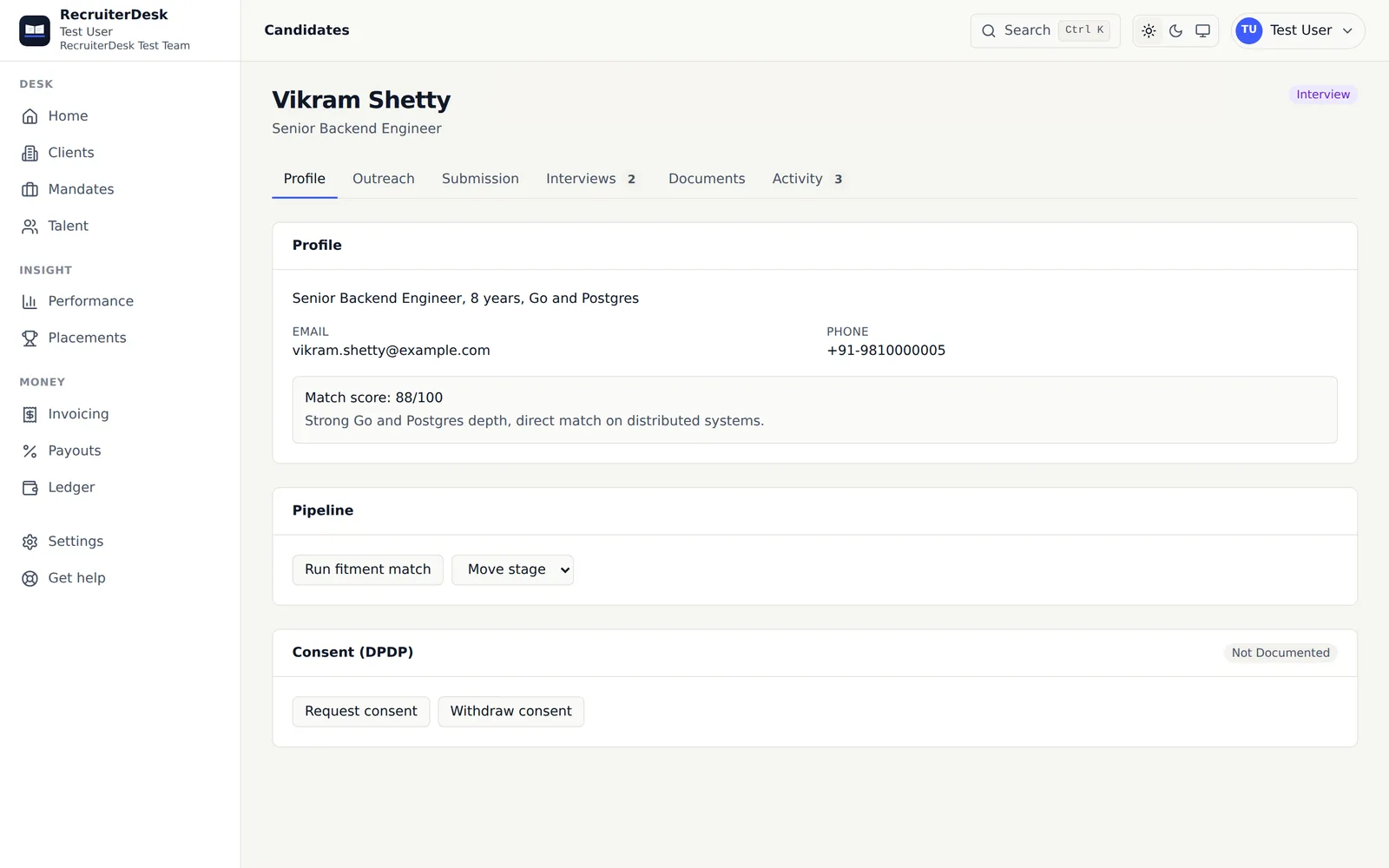
You do not need an enterprise applicant tracking system built for a large company’s internal HR team. You need one affordable workspace that holds your candidates, clients, mandates, pipeline and submissions together, lets you reach candidates, and makes you look like a firm to clients. That is exactly the shape RecruiterDesk is built in, for independent recruiters and boutique agencies, at one flat published price with every feature included and a free 7-day trial that needs no card. It turns each job description into a fitment checklist so your first shortlist lands, sends branded submissions from your own name, and, on the team plan, handles the money side of placements, payouts and settlements as you grow.
The rule for tools at the start is simple: keep them lean and flat-priced, and add machinery only when a real bottleneck forces it. Software should be a small monthly cost that saves you hours, not a big commitment you make before you have revenue.
Step 7: build a repeatable process
The agencies that last are the ones that turn ad-hoc effort into a repeatable process. From the first mandate, work the same way every time: agree the requirement up front, source and screen against it, submit with proof, chase feedback and interviews without letting anything stall, and keep every candidate and client relationship warm for the next role. For the mandate-by-mandate version of this, see how to run a recruitment mandate, and for keeping clients beyond a single role, client management for recruiters.
The honest summary
Starting a recruitment agency in India is cheap to begin and hard to sustain, and the difference is almost never the paperwork. Choose a narrow niche you understand, register the business and get GST right early, win a few clients on written terms before you spend on tools, and then run the whole desk on one lean, affordable workspace rather than a stack of spreadsheets.
Do the unglamorous parts well, the niche, the terms, the process, and the desk mostly runs itself. Get them wrong, and no tool will save you. Start narrow, keep it lean, and let real client demand pull the rest.
Frequently asked questions
How do I start a recruitment agency in India?
Start by choosing a narrow niche you know, then register a business (commonly a private limited company or an LLP), open a current account, and register for GST when you are required to. Line up two or three clients with written fee terms before you invest heavily in tools, and run the desk on one affordable workspace rather than a stack of spreadsheets. The niche and the first clients matter far more at the start than the paperwork.
Do I need GST registration for a recruitment agency in India?
Recruitment and staffing services are taxable, and registration is required once your turnover crosses the threshold or if you supply services across states, among other triggers. Many agencies register early so their invoicing is clean from the first placement. It is worth confirming your specific position with a chartered accountant, and there is a fuller explainer in our guide on GST for recruitment agencies.
How much does it cost to start a recruitment agency in India?
The real startup cost is low: business registration, a current account, and a laptop and phone you likely already have. The larger early costs are a job board subscription and your own time before the first placement lands. Software should be a small, flat monthly cost, not a big commitment, so keep it lean until fees are coming in.
What tools does a new recruitment agency need?
At the start you need a way to source candidates, a way to reach them, and one place to run your candidates, clients, mandates, pipeline and submissions. A single affordable workspace that covers the whole desk is enough; you do not need an enterprise applicant tracking system. Add tools only when a real bottleneck demands them.